

Application Area
Biomass Drying
Biomass Milling & Drying
The drying of biomass is common to many industries, including wood pellet making, panel boards, and many others, from coffee to olive oil or animal feed. Technologically, these industries operate drum / rotary dryers to dry biomass. It can be a raw material or a fuel for the manufacturing process.
Biomass Rotary Dryer Applications in Industry
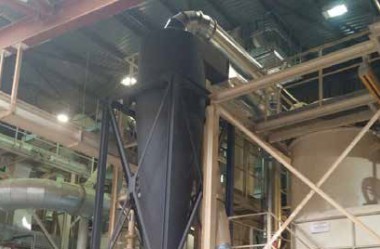
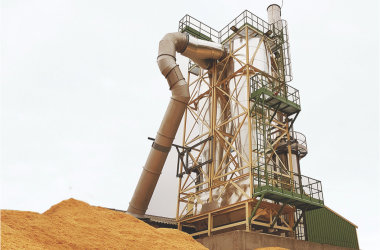
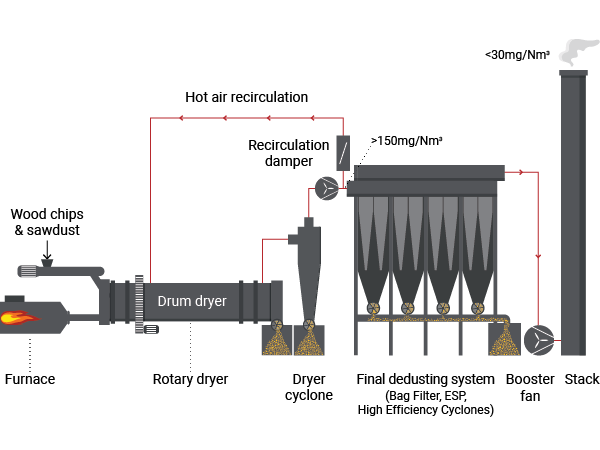
In the pellet-making industry, a common setup involves the use of a biomass rotary dryer, which is heated by a furnace (generally burning biomass) and followed by a dryer cyclone for primary particle separation. This configuration is widely replicated across other industries, ensuring efficient drying processes. A portion of the air is usually recirculated back into the biomass dryer for energy recovery, maximizing operational efficiency.
Challenges in Biomass Drying and Emission Control
Most of the coarser particles (Median Volume Diameter (MVD) >100µm) are recovered in the dryer cyclone but many of the fines and the fly ash from combustion end up in the stack. Their much lower size (MVD ~15µm) forces clients to use a final dedusting system to comply with stricter emission limits.
Typically, Wet Venturi Scrubbers or, in more environmentally strict cases, WESPs are used to reduce emissions under 50mg/Nm3, though with significant drawbacks. Scrubbers imply very high energy costs due to very high-pressure drops. WESPs work with low pressure drops but have high OPEX and CAPEX. Ultimately both require the use of water, originating secondary pollution.
Advanced Cyclone Systems: Efficient Biomass Dryers and Emission Control
Clients in biomass-based industries demand highly efficient, dry, and cost-effective dedusting systems capable of operating reliably over long periods with minimal maintenance. These systems must also ensure low production downtime while meeting stringent emission targets.
At Advanced Cyclone Systems (ACS), we provide robust, low-pressure-drop dryer cyclones that offer high efficiency and durability, meeting the needs of modern biomass operations. Our biomass dryers are complemented by advanced secondary cyclones, which serve as a sustainable and cost-effective alternative to traditional dedusting methods. ACS solutions can achieve emissions as low as 30mg/Nm³ without the high costs and maintenance demands associated with Wet Scrubbers or WESPs.