

Application Area
Nanoparticles
Product Recovery Nanoparticles: Properties, Applications, and Challenges
Nanoparticles are tiny particles with dimensions measured in nanometers, where one nanometer equals one billionth of a meter (10^-9 meters). Due to their small size and high surface area-to-volume ratio, nanoparticles exhibit unique properties that enhance their ability to interact with other molecules, making them ideal for applications in drug delivery, electronics, and cosmetics.
Types of Nanoparticles and Their Applications
Nanoparticles are categorized based on their composition, shape, and unique properties. Different types of nanoparticles are utilized in various industries, from medicine to electronics. Below are the most common types of nanoparticles and their applications.
Semiconductor Nanoparticles: Unique Optical Properties
- Semiconductor nanoparticles, including quantum dots: They have unique optical properties that make them useful for applications such as solar cells, drug delivery, electronics and biological imaging. Examples: zync oxide (ZnO NPs) or silicon (SiNPs) nanoparticles.
- Metal nanoparticles: These nanoparticles are made of metals, such as gold, silver, and copper. They are used in a variety of applications, including electronics, catalysis, and medicine.
- Carbon nanotubes: These nanoparticles are made of carbon atoms arranged in a cylindrical shape. They are very strong and lightweight, and they are used in a variety of applications, such as electronics, composites, and drug delivery.
- Polymeric nanoparticles: These nanoparticles are made of polymers, such as polystyrene and polylactic acid. They are used in a variety of applications, such as drug delivery, cosmetics, and food packaging.
Methods for Nanoparticle Production and Associated Challenges
Several production methods exist for generating nanoparticles, each requiring effective gas/solid separation techniques. Some methods, such as flame spray pyrolysis, CVD, arc discharge, laser ablation, and sonochemical synthesis, are among the most commonly used, with unique challenges related to capturing and handling these fine particles.
There are many different methods for producing nanoparticles where gas / solid separation is necessary. Some of the most common methods include:
- Flame spray pyrolysis when a metal or metal salt is sprayed into a flame, where it vaporizes and then condenses to form NPs,
- Chemical vapor deposition (CVD), where material vapor (e.g. ZnO) is generated and then condensed to form NPs.
- Arc discharge: where an electric arc is created between two electrodes, which vaporizes the electrodes and forms nanoparticles.
- Laser ablation: when a laser is used to ablate a metal or metal salt, which vaporizes and then condenses to form nanoparticles.
- Sonochemical synthesis: when ultrasound waves are used to break down a metal or metal salt into nanoparticles.
ACS Solutions for Nanoparticle Separation
Nanoparticles pose several challenges for gas/solid separation. Nanoparticles are very small, which makes them difficult to capture with regular cyclones and other mechanical separators. NPs can easily pass through the pores of bag filters or clog the filter elements. They can also change its characteristics and degradate when holding in the filters - a problem which is common to electrostatic precipitators. Finally, wet scrubbers pose even more problems if the nanoparticles are soluble or degrade in a liquid phase.
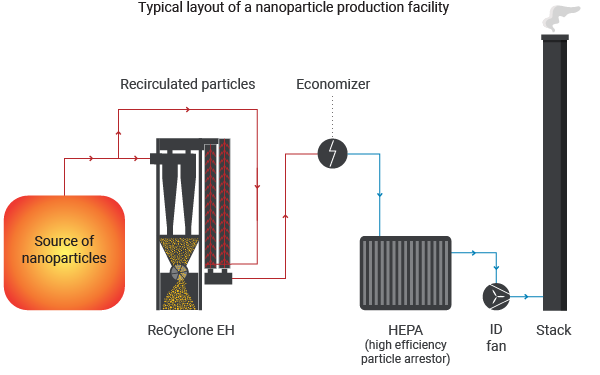
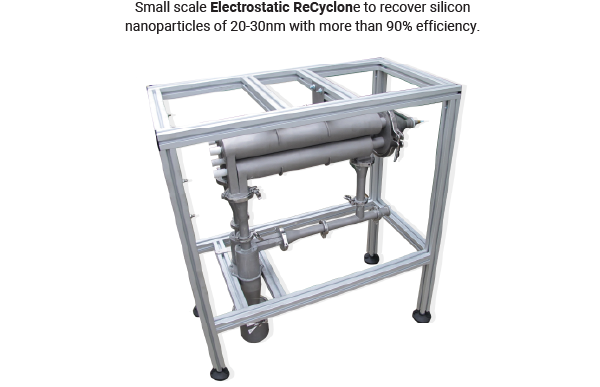
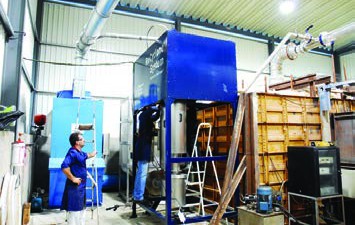
ACS solutions include cyclones with electrostatic recirculation (ReCyclone EH) which allow for a direct particle capture, avoiding particle degradation and aggregation, using electrostatic recirculation. The ReCyclone EH has shown efficiencies of more than 95% to capture ZnO NPs with a median size of ~1 μm (Case Study) and more than 90% to capture silicon nanoparticles of 20-30nm (NASA Article- Pages 32, 33 and 34).